Franklin Stud Finder Guide: ProSensor Models & Multi-Sense
Franklin Sensors fundamentally disrupted the home improvement industry by solving the #1 frustration of stud finding: calibration errors and false positives. With their patented Multi-Sense 13-sensor array, Franklin scanners instantly illuminate the full 1.5-inch width of a wall stud the second you place the tool against the drywall. Learn how Franklin models work, compare the ProSensor lineup, and see how they stack up against traditional tools in our best stud finder rankings.
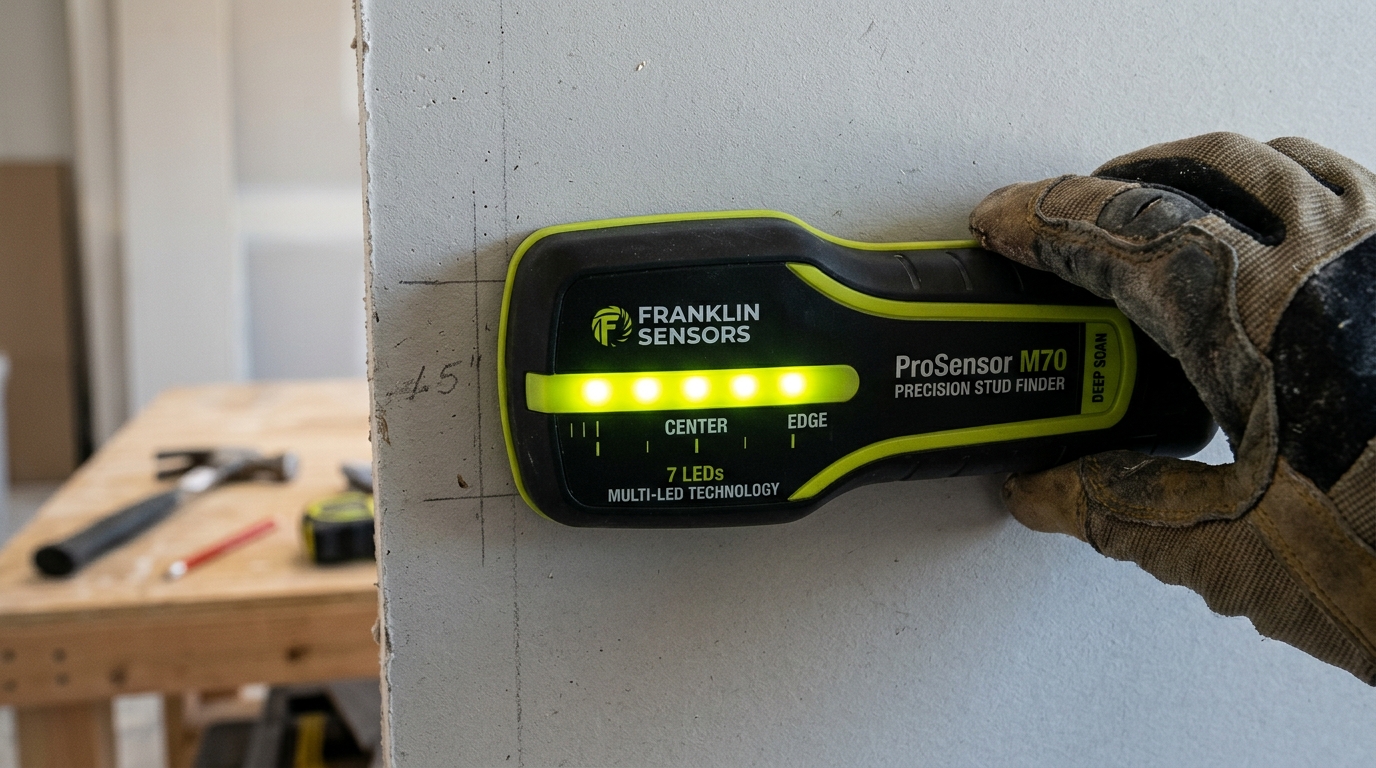
Full 1.5" Stud Width at a Glance
While traditional single-sensor scanners force you to slide back and forth to find boundaries, Franklin Sensors read across 7 inches of wall simultaneously. Simply press the button: LEDs illuminate the entire stud width instantly.
Franklin Sensors ProSensor Lineup
Compare sensor counts, scan depths, and ergonomic features across the flagship Franklin ProSensor models.
| Model | Sensors / LEDs | Max Scan Depth | Width of Sensor Field | Built-In Level | Battery Type | Approx Price |
|---|---|---|---|---|---|---|
| ProSensor 710+ | 13 Precision LEDs | 1.6" (40 mm) | 7.0 inches | Yes (Integrated bubble level) | 2 x AA | $49.99 |
| ProSensor M150 | 9 Precision LEDs | 1.5" (38 mm) | 5.2 inches | No (Compact form) | 2 x AAA | $34.99 |
| ProSensor T13 | 13 Precision LEDs | 1.6" (40 mm) | 7.0 inches | Yes + Pencil Caddy | 2 x AA | $54.99 |
| ProSensor M210 | 13 Precision LEDs | 1.7" (43 mm) | 7.0 inches | No | 2 x AA | $44.99 |
1. The Engineering Behind Multi-Sense Technology
Traditional capacitive scanners possess a single dielectric sensor pad measuring approximately 1 square inch. To identify a stud, the user must calibrate the tool over a hollow cavity and move it across the wall so the microprocessor can identify the mathematical change in capacitance.
Franklin Sensors completely reimagined this architecture. By embedding 13 independent dielectric sensor elements spaced along a 7-inch horizontal frame, the unit takes 13 simultaneous density measurements every fraction of a second.
When a single-sensor tool hits a patch of joint compound or uneven paint, it interprets the localized density increase as a stud. In contrast, Franklin’s microprocessor analyzes the relationship between all 13 sensors. It only lights up when it sees a distinct 1.5-inch wide density peak surrounded by hollow cavities, ignoring localized surface imperfections.
2. Identifying Double Studs, King Studs & Headers
Framing walls involves more than just single 2x4 studs spaced at 16 inches. Around door frames, window openings, and wall intersections, carpenters nail multiple studs together:
A single-sensor edge finder gets hopelessly confused by double studs because there is no hollow cavity between them. A Franklin ProSensor clearly illuminates the wide 3-inch or 4.5-inch band, giving you complete structural visibility.
3. Franklin Sensors vs. Zircon: Which Should You Buy?
Choose Franklin Sensors If:
- ✓ You want fast, effortless press-and-read operation.
- ✓ You hate calibration errors and continuous beeping.
- ✓ You need to mount heavy TVs into double studs or headers.
- ✓ You prefer standard AA batteries over 9-volt batteries.
Choose Zircon If:
- ✓ You need continuous live 120V AC electrical wire detection.
- ✓ You need a dedicated Metal Scan mode for copper plumbing pipes.
- ✓ You want a slim, narrow body that fits into tight 8-inch corners.
- ✓ Read our complete Zircon stud finder guide.
Frequently Asked Questions
Quick, authoritative answers to common wood framing, building code, and stud spacing questions.