Wall Stud Finders: Sensor Types, Depth & Science
A wall stud finder is a precision diagnostic tool engineered to reveal the hidden vertical wood framing studs and metal channels concealed behind finished drywall, plaster, and tile. To select the right tool for your project, it helps to understand the underlying physics of dielectric capacitance, magnetic flux, and radio frequency radar. Looking for top models? Review our best stud finder comparison guide.
Quick Key Takeaways
- ✓Capacitive Sensors: Measure changes in dielectric constant; best for clean 1/2" and 5/8" drywall.
- ✓Magnetic Sensors: Detect steel drywall screws and lath nails; ideal for historic plaster walls.
- ✓Radar Imaging (RF): Scans up to 4" deep; distinguishes wood, PVC pipes, and metal conduits.
- ✓Scan Depth: Standard mode reads 3/4" (drywall); DeepScan mode penetrates up to 1.5" (double sheetrock).
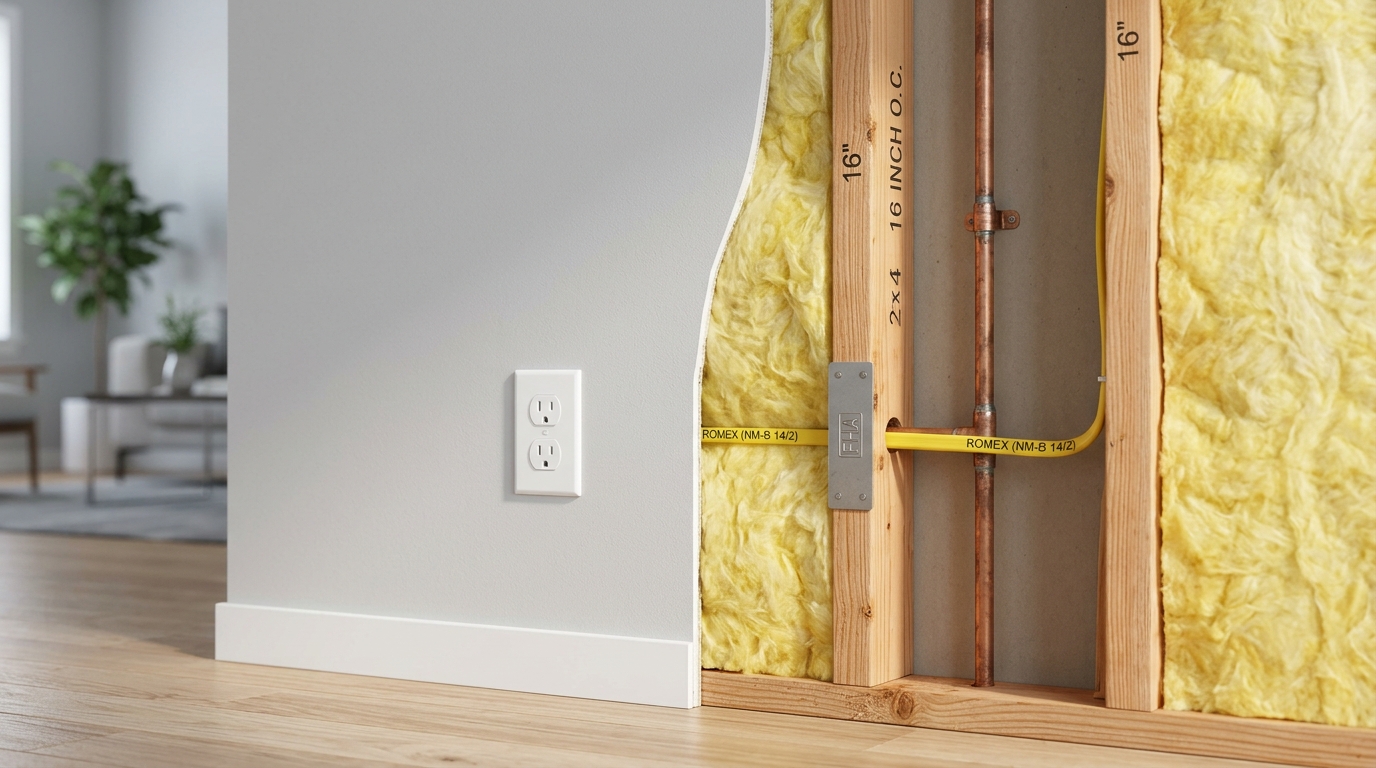
Anatomy Behind the Wall
Wall stud finders must differentiate between 1.5" wood studs, 120V Romex electrical cables, and copper pipes through 1/2" to 5/8" drywall or plaster.
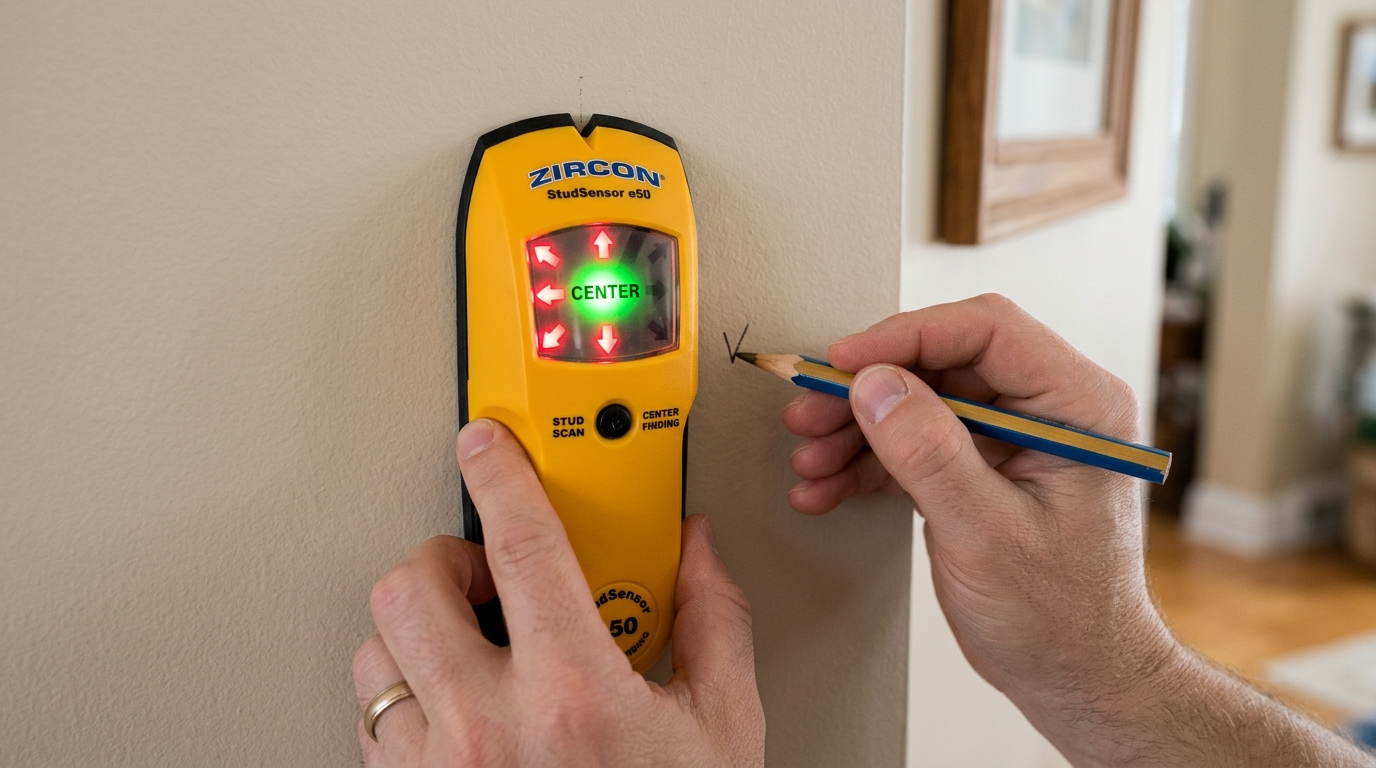
Dielectric Calibration
Capacitive sensors evaluate relative permittivity (dielectric constant k), sensing density surges from hollow air (k=1.0) to Douglas fir studs (k=3.0).
Wall Material vs. Stud Finder Sensor Compatibility
Different wall finishes require distinct detection technologies. Use this matrix to match your wall to the correct scanner.
| Wall Substrate | Typical Thickness | Capacitive (Zircon/DeWalt) | Multi-Sensor (Franklin) | Magnetic (C.H. Hanson) | Radar / 3D (Walabot) |
|---|---|---|---|---|---|
| Standard Drywall | 1/2" (12.7 mm) | Excellent | Best Choice | Reliable (Finds screws) | Excellent |
| Firecode Drywall (Type X) | 5/8" (15.9 mm) | Requires DeepScan | Excellent | Reliable | Excellent |
| Double Drywall (Party Wall) | 1.0" - 1.25" | DeepScan Only | Strong (1.6" depth) | Weak pull | Best Choice |
| Historic Lath and Plaster | 0.75" - 1.5" | Poor (False readings) | Moderate | Best Choice (Tracks lath nails) | Unreliable on wire lath |
| Bathroom Tile over Cement Board | 0.75" - 1.25" | Fails | Weak | Reliable (Finds screws) | Best Choice (Sees through tile) |
| Wood Paneling / Shiplap | 0.5" - 0.75" | Requires DeepScan | Excellent | Moderate | Excellent |
1. How Capacitive Stud Finders Work (Dielectric Constants)
The overwhelming majority of modern stud finders—including models from Zircon, DeWalt, and Craftsman—are capacitive dielectric sensors.
These tools contain sensor plates that create an electrostatic field radiating through the drywall. Every building material possesses a measurable physical property called a dielectric constant:
When you slide the scanner across the wall, the capacitance spikes as the sensor passes over the dense wood stud. Learn how to calibrate and avoid common errors in our guide to using a stud finder.
2. Multi-Sensor Technology (The Franklin Sensors Innovation)
While traditional tools use a single capacitor and require you to slide the device from left to right to locate boundaries, multi-sensor arrays (such as the Franklin Sensors ProSensor series) pack up to 13 separate sensors along a 7-inch horizontal bar.
Because the tool monitors multiple points along the wall simultaneously, it compares readings across the sensors in real time. It illuminates the full 1.5-inch width of the stud without needing calibration or sliding, and can even identify irregular framing like double studs or corner posts.
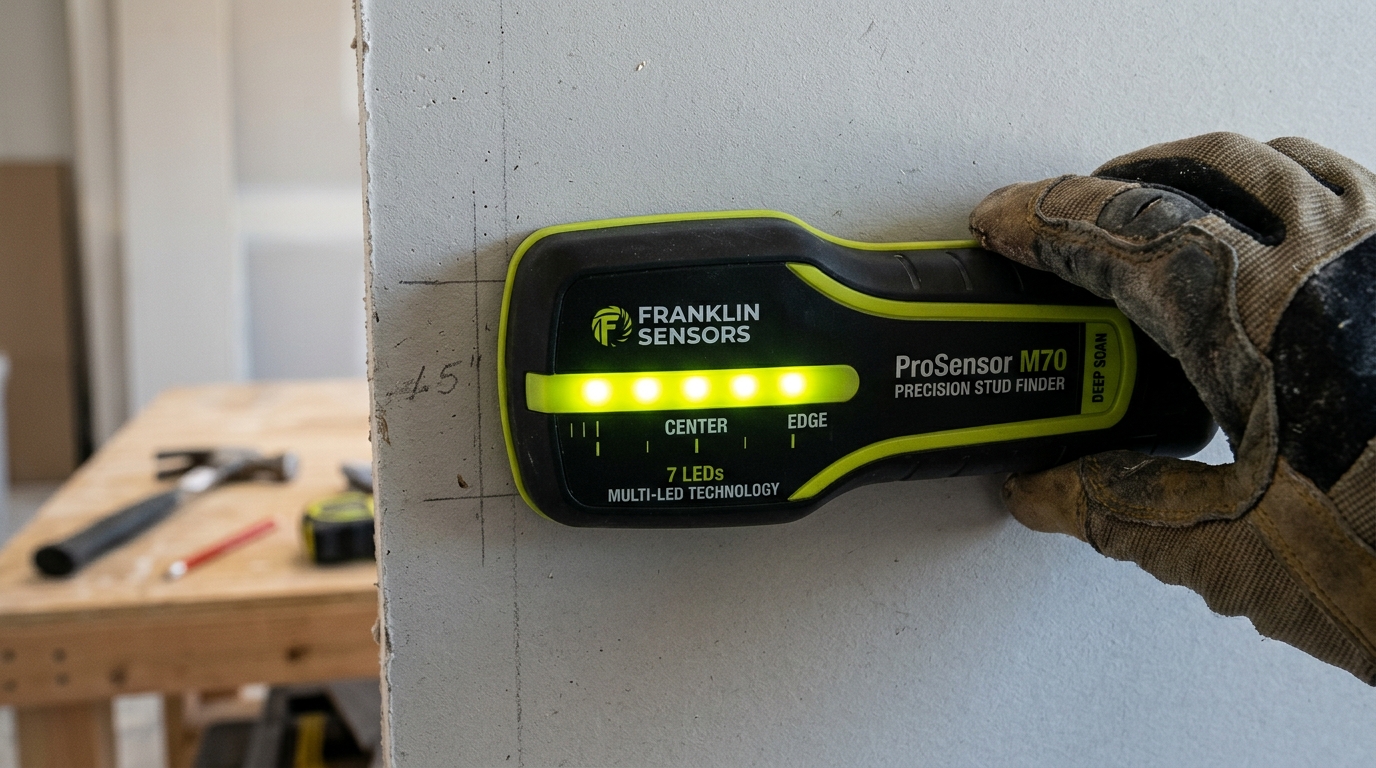
Instant Full 1.5" Width LED Bar
Eliminates the back-and-forth sliding ritual. The 13 independent precision sensor pads analyze density across 7 inches at 100 scans per second.
3. Magnetic Stud Finders (Zero-Battery Simplicity)
Magnetic stud finders do not detect wood. Instead, they use powerful rare-earth neodymium magnets to detect the steel drywall screws or lath nails driven into the framing members.
The Vertical Nail-Line Rule: In drywall construction, drywallers place screws every 12 to 16 inches vertically along each stud. By sliding a magnetic stud finder up and down vertically once a screw is found, you can locate 2 or 3 additional screws in a perfect vertical column, confirming the true axis of the stud.
Why It Wins on Plaster: Because historic lath and plaster walls are held together by hundreds of steel lath nails driven into studs every 1-2 inches, magnetic finders snap reliably to plaster walls where electronic tools produce false alarms.
4. Ultra-Wideband Radar (Walabot & Commercial Scanners)
The cutting edge of wall detection technology is radio frequency (RF) ultra-wideband radar. Scanners like the Walabot DIY 2 and the commercial Milwaukee Sub-Scanner M12 emit low-power microwave pulses into the wall cavity.
The receiver processes the reflected wave signals to compute the exact shape, density, and depth of objects up to 4 inches deep, visually distinguishing between:
- Structural Wood Framing: 1.5-inch rectangular wood reflection.
- Metal Studs & Conduit: High-reflectivity metallic response.
- Plumbing Pipes: Cylindrical profile detection (PVC and copper).
- Live Electrical Cables: Unshielded 50/60 Hz electromagnetic field overlays.
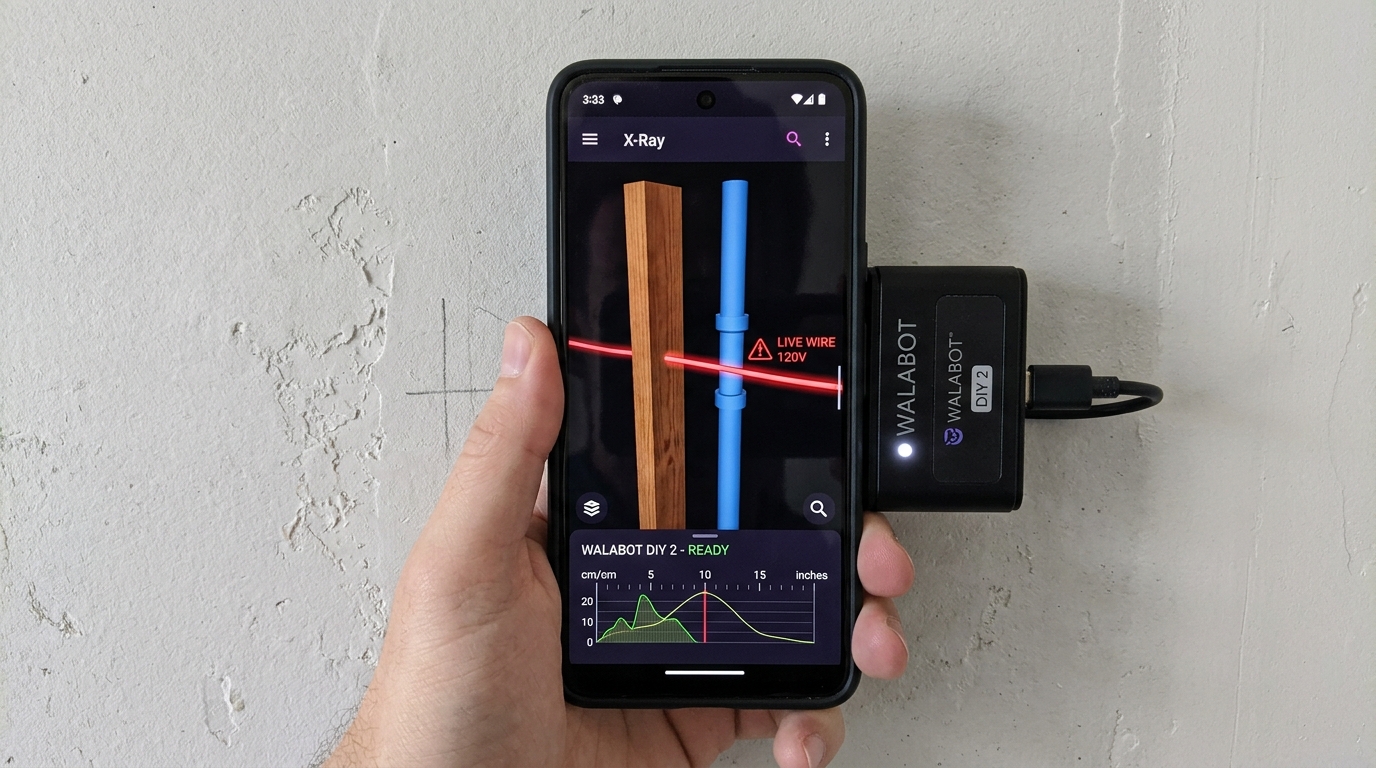
4-Inch Deep Visual X-Ray
Detects objects through ceramic tile, lath & plaster, and double drywall where traditional capacitive sensors fail.
Frequently Asked Questions
Quick, authoritative answers to common wood framing, building code, and stud spacing questions.